GtoPdb is requesting financial support from commercial users. Please see our sustainability page for more information.
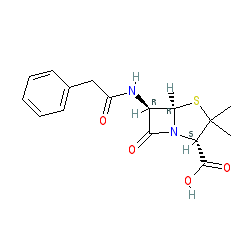
penicillin G 
GtoPdb Ligand ID: 4796
|
Synonyms: benzylpenicillin | penicillin G sodium | penicillin-G potassium


penicillin G is an approved drug (FDA (1947))
Compound class:
Natural product
Comment: Penicillin G (benzylpenicillin) is a narrow spectrum penicillin antibacterial. Penicillin G for clinical use is produced through biological fermentation of the Penicillium chrysogenum fungus which produces the compound naturally.
It is one of the access group antibacterials on the World Health Organization's Model List of Essential Medicines (link provided in the Classification table under the Summary tab). |
|
|||||||||||||||||||||||||||||||||||

| Transporters Moving this Compound Across a Lipid Membrane | ||||||||||||
|
||||||||||||
| Targets where the ligand is described in the comment field | |
| Target | Comment |
| Peptide transporter 1 | Although most di/tripeptides can bind PEPT1, not all of them are substrates. The uptake depends on the structural features (charge, hydrophobicity, size, side chain flexibility, etc.) of the di/tripeptide. A variety of dipeptides and drugs interact with PEPT1, including D-Phe-Ala [10,23], D-Phe-Gln [1], cyclo(L-Hyp-L-Ser) (i.e. JBP485) [5,27], nateglinide [38], glibenclamide [32] and penicillin G (benzylpenicillin) [2]. Among many other molecules, PEPT1 has been shown to interact with L-Dopa-L-Phe [35,41], D-Phe-Gly-L-Dopa [44], JBP485 prodrugs (e.g. JBP485-3-CH2-O-valine, J3V) [21], 5-Aminosalicylic acid (5-ASA) derivatives (i.e. Gly-ASA, Glu-ASA, Val-ASA) [30,55], cinnabar (i.e. α-HgS >96%) [48], doxorubicin-tripeptide (i.e. doxorubicin-Gly-Gly-Gly) [13], scutellarin methyl ester-4'-dipeptide conjugates (e.g. scutellarin methyl ester-4'-Val-homo-Leu) [26], curcumin (CUR)-peptide derivatives (i.e. CUR-Phe-Val, CUR-Ile-Val) [56], gemcitabine amino acid ester prodrugs (i.e. 5'-L-valyl-gemcitabine, V-Gem) [33,40], decitabine amino acid ester prodrugs (e.g. 5'-O-L-valyl-decitabine, L-Val-DAC) [36-37], didanosine amino acid ester prodrugs (e.g. 5'-O-L-valyl-didanosine, L-Val-DDI) [54], floxuridine amino acid ester prodrugs (e.g. 5'-L-isoleucyl and 5'-L-valyl amino acid ester prodrugs of floxuridine) [24-25], floxuridine amino acid monoester prodrugs (e.g. 5'-O-D-valyl-floxuridine) [43], floxuridine dipeptide monoester prodrugs (e.g. 5'-L-phenylalanyl-L-tyrosyl-floxuridine, 5'-L-phenylalanyl-L-glycyl-floxuridine, and 5'-L-isoleucyl-L-glycyl-floxuridine) [42], amino acid acyloxy ester prodrugs of guanidine oseltamivir carboxylate (GOC) (e.g. GOC-L-Val, the L-valyl acyloxy ethyl prodrug of GOC) [17] and the valyl amino acid prodrug of GOC with the isopropyl-methylene-dioxy linker (i.e. GOC-ISP-Val) [20], amino acid acyloxy ester prodrugs of zanamivir (Zan, e.g. Zan-L-Val, the L-valyl acycloxy ethyl prodrug of Zan) [18], peramivir-(CH2)2-L-Val and peramivir-L-Ile [34], thiodipeptide prodrugs of for example, ibuprofen and propofol [11], alanylpyrraline (Ala-Pyrr) and pyrralylalanine (Pyrr-Ala) [12], dipeptide-bound derivatives of N6-(carboxymethyl)lysine (CML) and N6-(1-carboxyethyl)-lysine (CEL) (i.e. Ala-CML, CML-Ala, Ala-CEL, CEL-Ala) [19], Flammulina velutipes polysaccharide(FVP)-iron(III) complex [FVP-Fe(III) complex] [6], dipeptides of p-borono-L-phenylalanine (BPA) and tyrosine (i.e. L-Tyr-p-L-BPA (Tyr-BPA), p-L-BPA-L-tyrosine (BPA-Tyr)) [29] and AuIII‐peptidodithiocarbamato complexes of the type [AuIIIBr2(dtc‐AA1‐AA2‐OR], in which AA1 = N‐methylglycine (Sar), L/D-Pro; AA2 = L/D-Ala, α‐aminoisobutyric acid (Aib); R = OtBu, triethylene glycol methyl ether) (e.g. dtc‐Pro‐Aib‐OtBu) [3]. In recent years, PEPT1 has been shown to interact with a large variety of specifically targeted (i.e. peptide- or amino acid-functionalized) nanoparticles [7-9,14-15,49], (nano)micelles [22,45,47,53] and nanocomposites [16,46,51-52]. |
| Peptide transporter 2 | Although most di/tripeptides can bind PEPT2, not all of them are substrates. The uptake depends on the structural features (charge, hydrophobicity, size, side chain flexibility, etc.) of the di/tripeptide. Like PEPT1, PEPT2 interacts with dipeptides and drugs including D-Phe-Ala [10,39], nateglinide [38], glibenclamide [32], penicillin G (benzylpenicillin) [31], polymyxins (i.e. polymyxin B and colistin) [28] and entecavir [50]. PEPT2 has been shown to interact with dipeptides of p-borono-L-phenylalanine (BPA) and tyrosine (i.e. L-Tyr-p-L-BPA (Tyr-BPA), p-L-BPA-L-tyrosine (BPA-Tyr)) [29] and with AuIII‐peptidodithiocarbamato complexes of the type [AuIIIBr2(dtc‐AA1‐AA2‐OR), in which AA1 = N‐methylglycine (Sar), L/D‐Pro; AA2 = L/D‐Ala, α‐aminoisobutyric acid (Aib); R = OtBu, triethylene glycol methyl ether, e.g. dtc‐Pro‐Aib‐OtBu) [3]. |



 This work is licensed under a Creative Commons Attribution-ShareAlike 4.0 International License