From August 18th 2026, GtoPdb will require users to register to use the website. Please see our blog post for more information.
ASF24 
GtoPdb Ligand ID: 14309
|
Synonyms: ASF-24

Compound class:
Synthetic organic
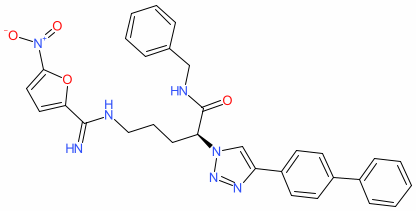
Comment: ASF24 is a small-molecule that inhibits STING-dependent signalling [1]. The compound's nitrofuran warhead covalently modifies the protein's Cys292 residue, which thereby prevents STING functional oligomerization.

Ligand Activity Visualisation ChartsThese are box plot that provide a unique visualisation, summarising all the activity data for a ligand taken from ChEMBL and GtoPdb across multiple targets and species. Click on a plot to see the median, interquartile range, low and high data points. A value of zero indicates that no data are available. A separate chart is created for each target, and where possible the algorithm tries to merge ChEMBL and GtoPdb targets by matching them on name and UniProt accession, for each available species. However, please note that inconsistency in naming of targets may lead to data for the same target being reported across multiple charts. ✖ |
|
|||||||||||||||||||||||||||||||||||
| Selectivity at other protein targets | ||||||||||||||||||||||||||||||||||
| Key to terms and symbols | Click column headers to sort | |||||||||||||||||||||||||||||||||
|
||||||||||||||||||||||||||||||||||



 This work is licensed under a Creative Commons Attribution-ShareAlike 4.0 International License