GtoPdb is requesting financial support from commercial users. Please see our sustainability page for more information.
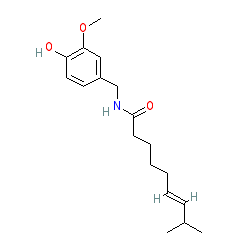
capsaicin 
GtoPdb Ligand ID: 2486
|
Synonyms: Qutenza®


capsaicin is an approved drug (EMA & FDA (2009))
Compound class:
Natural product
Comment: Although capsaicin was approved by the US FDA in 2009, this compound was previously marketed so was not subject to a New Drug Application.

Ligand Activity Visualisation ChartsThese are box plot that provide a unique visualisation, summarising all the activity data for a ligand taken from ChEMBL and GtoPdb across multiple targets and species. Click on a plot to see the median, interquartile range, low and high data points. A value of zero indicates that no data are available. A separate chart is created for each target, and where possible the algorithm tries to merge ChEMBL and GtoPdb targets by matching them on name and UniProt accession, for each available species. However, please note that inconsistency in naming of targets may lead to data for the same target being reported across multiple charts. ✖ |
|
|||||||||||||||||||||||||||||||||||
| References |
|
1. Caterina MJ, Schumacher MA, Tominaga M, Rosen TA, Levine JD, Julius D. (1997)
The capsaicin receptor: a heat-activated ion channel in the pain pathway. Nature, 389 (6653): 816-24. [PMID:9349813] |
|
2. Correll CC, Phelps PT, Anthes JC, Umland S, Greenfeder S. (2004)
Cloning and pharmacological characterization of mouse TRPV1. Neurosci Lett, 370 (1): 55-60. [PMID:15489017] |
|
3. Grissmer S, Nguyen AN, Aiyar J, Hanson DC, Mather RJ, Gutman GA, Karmilowicz MJ, Auperin DD, Chandy KG. (1994)
Pharmacological characterization of five cloned voltage-gated K+ channels, types Kv1.1, 1.2, 1.3, 1.5, and 3.1, stably expressed in mammalian cell lines. Mol Pharmacol, 45 (6): 1227-34. [PMID:7517498] |
|
4. Kalman K, Nguyen A, Tseng-Crank J, Dukes ID, Chandy G, Hustad CM, Copeland NG, Jenkins NA, Mohrenweiser H, Brandriff B et al.. (1998)
Genomic organization, chromosomal localization, tissue distribution, and biophysical characterization of a novel mammalian Shaker-related voltage-gated potassium channel, Kv1.7. J Biol Chem, 273 (10): 5851-7. [PMID:9488722] |
|
5. Liu Q, Wang X. (2013)
Effect of TRPV2 cation channels on the proliferation, migration and invasion of 5637 bladder cancer cells. Exp Ther Med, 6 (5): 1277-1282. [PMID:24223658] |
|
6. Monet M, Gkika D, Lehen'kyi V, Pourtier A, Vanden Abeele F, Bidaux G, Juvin V, Rassendren F, Humez S, Prevarsakaya N. (2009)
Lysophospholipids stimulate prostate cancer cell migration via TRPV2 channel activation. Biochim Biophys Acta, 1793 (3): 528-39. [PMID:19321128] |
|
7. Nabissi M, Morelli MB, Santoni M, Santoni G. (2013)
Triggering of the TRPV2 channel by cannabidiol sensitizes glioblastoma cells to cytotoxic chemotherapeutic agents. Carcinogenesis, 34 (1): 48-57. [PMID:23079154] |
|
8. Oulidi A, Bokhobza A, Gkika D, Vanden Abeele F, Lehen'kyi V, Ouafik L, Mauroy B, Prevarskaya N. (2013)
TRPV2 mediates adrenomedullin stimulation of prostate and urothelial cancer cell adhesion, migration and invasion. PLoS One, 8 (5): e64885. [PMID:23741410] |
|
9. Perálvarez-Marín A, Doñate-Macian P, Gaudet R. (2013)
What do we know about the transient receptor potential vanilloid 2 (TRPV2) ion channel?. FEBS J, 280 (21): 5471-87. [PMID:23615321] |
|
10. Santoni G, Amantini C, Maggi F, Marinelli O, Santoni M, Nabissi M, Morelli MB. (2020)
The TRPV2 cation channels: from urothelial cancer invasiveness to glioblastoma multiforme interactome signature. Lab Invest, 100 (2): 186-198. [PMID:31653969] |
|
11. Shoji KF, Bayet E, Leverrier-Penna S, Le Devedec D, Mallavialle A, Marionneau-Lambot S, Rambow F, Perret R, Joussaume A, Viel R et al.. (2023)
The mechanosensitive TRPV2 calcium channel promotes human melanoma invasiveness and metastatic potential. EMBO Rep, 24 (4): e55069. [PMID:36744297] |
|
12. Voets T, Droogmans G, Wissenbach U, Janssens A, Flockerzi V, Nilius B. (2004)
The principle of temperature-dependent gating in cold- and heat-sensitive TRP channels. Nature, 430 (7001): 748-54. [PMID:15306801] |



 This work is licensed under a Creative Commons Attribution-ShareAlike 4.0 International License