From August 18th 2026, GtoPdb will require users to register to use the website. Please see our blog post for more information.
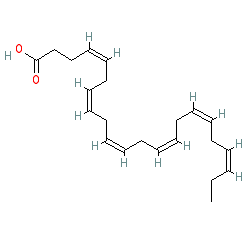
docosahexaenoic acid 
GtoPdb Ligand ID: 1051
|
Abbreviated name: DHA
Synonyms: all-cis-DHA | all-cis-docosa-4,7,10,13,16,19-hexaenoic acid | doconexent | Omega 3 fatty acid | Omega-3 marine triglycerides | Retriacyl® (proposed trade name)

Compound class:
Metabolite
Comment: Docosahexaenoic acid is an endogenous omega-3 fatty acid, activating all 3 retinoid X receptor isoforms. It has no activity at retinoic acid receptors (RARs), the thyroid hormone receptor or the vitamin D receptor (VDR).

Ligand Activity Visualisation ChartsThese are box plot that provide a unique visualisation, summarising all the activity data for a ligand taken from ChEMBL and GtoPdb across multiple targets and species. Click on a plot to see the median, interquartile range, low and high data points. A value of zero indicates that no data are available. A separate chart is created for each target, and where possible the algorithm tries to merge ChEMBL and GtoPdb targets by matching them on name and UniProt accession, for each available species. However, please note that inconsistency in naming of targets may lead to data for the same target being reported across multiple charts. ✖ |
|
|||||||||||||||||||||||||||||||||||
| References |
|
1. Briscoe CP, Tadayyon M, Andrews JL, Benson WG, Chambers JK, Eilert MM, Ellis C, Elshourbagy NA, Goetz AS, Minnick DT et al.. (2003)
The orphan G protein-coupled receptor GPR40 is activated by medium and long chain fatty acids. J Biol Chem, 278 (13): 11303-11. [PMID:12496284] |
|
2. Desvergne B, Wahli W. (1999)
Peroxisome proliferator-activated receptors: nuclear control of metabolism. Endocr Rev, 20 (5): 649-88. [PMID:10529898] |
|
3. Hoffman DR, Hughbanks-Wheaton DK, Pearson NS, Fish GE, Spencer R, Takacs A, Klein M, Locke KG, Birch DG. (2014)
Four-year placebo-controlled trial of docosahexaenoic acid in X-linked retinitis pigmentosa (DHAX trial): a randomized clinical trial. JAMA Ophthalmol, 132 (7): 866-73. [PMID:24805262] |
|
4. Hossain S, Hashimoto M, Katakura M, Miwa K, Shimada T, Shido O. (2009)
Mechanism of docosahexaenoic acid-induced inhibition of in vitro Abeta1-42 fibrillation and Abeta1-42-induced toxicity in SH-S5Y5 cells. J Neurochem, 111 (2): 568-79. [PMID:19686246] |
|
5. Itoh Y, Kawamata Y, Harada M, Kobayashi M, Fujii R, Fukusumi S, Ogi K, Hosoya M, Tanaka Y, Uejima H et al.. (2003)
Free fatty acids regulate insulin secretion from pancreatic beta cells through GPR40. Nature, 422 (6928): 173-6. [PMID:12629551] |
|
6. Lampen A, Meyer S, Nau H. (2001)
Phytanic acid and docosahexaenoic acid increase the metabolism of all-trans-retinoic acid and CYP26 gene expression in intestinal cells. Biochim Biophys Acta, 1521 (1-3): 97-106. [PMID:11690641] |
|
7. Lesage F, Terrenoire C, Romey G, Lazdunski M. (2000)
Human TREK2, a 2P domain mechano-sensitive K+ channel with multiple regulations by polyunsaturated fatty acids, lysophospholipids, and Gs, Gi, and Gq protein-coupled receptors. J Biol Chem, 275 (37): 28398-405. [PMID:10880510] |
|
8. Motter AL, Ahern GP. (2012)
TRPA1 is a polyunsaturated fatty acid sensor in mammals. PLoS ONE, 7 (6): e38439. [PMID:22723860] |



 This work is licensed under a Creative Commons Attribution-ShareAlike 4.0 International License